The short answer
| If you need to charge | Look for | About |
|---|---|---|
| A phone, through one day | 10,000 mAh | 36 Wh |
| A phone for a weekend, or two devices | 20,000 mAh | 72 Wh |
| A laptop as well as a phone | 20,000–25,000 mAh with a USB-C port that matches your laptop charger | 72–90 Wh |
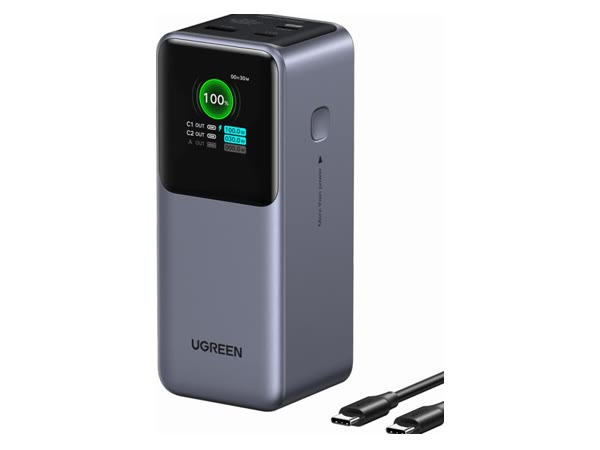
Watt-hours worked out at 3.6 V, the voltage UGREEN uses on its spec sheets. All three stay under the 100 Wh airline limit.
Why you get less than the label says
Some energy is lost as heat when a power bank charges your phone, so you never get the full rated capacity into your device. As an example, Anker says its 90 Wh laptop power bank charges an iPhone 16 Pro about five times. The phone's battery is listed at 13.94 Wh, so five charges is roughly 70 Wh of the 90.
A quick way to plan: find your phone's battery size in Wh (or mAh) on its spec page, and expect to get around three-quarters of the power bank's rating into it.
Capacity is not the only number
For a laptop, the output matters as much as capacity. Check the wattage printed on your laptop's own charger, then look for a power bank whose single USB-C port matches it. The maker's "single port" or "USB-C1" figure is the one to read, not the total.
If you fly
Stay under 100 Wh and you can take it in your carry-on on any airline without asking. That means about 27,000 mAh at most. See Can you take a power bank on a plane?
Which one to buy
Our best power banks for flights guide has a pick at 20,000 mAh and a budget pick at 10,000 mAh.
Sources
- UGREEN US: 25000mAh 145W power bank (25000mAh/3.6V/90Wh), accessed 3 Oct 2026
- Anker US: Laptop Power Bank 25K 165W, accessed 3 Oct 2026
- FAA PackSafe: lithium batteries, accessed 3 Oct 2026